How We Get That Moody, Layered Glow: A Room-by-Room Lighting Guide


If you’ve heard me say it once, you’ve heard me say it a million times: layered lighting is the best way to make a room feel more elevated and inviting. From ambient lighting to task lighting to accent lighting, every room needs planes of light that bounce off of various parts of the room and give that glow that makes you want to linger longer.
Lighting honestly has as much impact on a space as paint color, flooring, or finishes. Below, I’m walking through every type of fixture we use in our home — overhead lighting, sconces, and lamps — plus the rules, finishes, and sources I reach for over and over. Think of this as the master guide.
First, a Quick Refresher on Layered Lighting
Before we get into fixture types, let’s talk about the three layers every room needs. A common mistake I see over and over is a single overhead light doing all the work in a room. One light source = flat, uninviting, and usually way too bright.
Here’s the simple version (for the deep dive, head over to our full layered lighting guide):
- Ambient lighting is your general, overall glow. Think chandeliers, flush mounts, recessed lights — the lighting that substitutes for natural window light.
- Task lighting is the functional layer — bedside lamps for reading, pendants over a kitchen island, a desk lamp in the study.
- Accent lighting is the mood-booster. Picture lights over art, sconces, bookshelf lights, anything that highlights an architectural feature or draws the eye where you want it to go.
My rule of thumb: every room should have at least 2–3 sources of light. Our bedroom has all three (chandelier + nightstand lamps + picture light over the bed), and our living room has twelve light sources — not counting the chandelier, the candles, or the fireplace. That’s the secret to that layered, moody glow.

Don’t Forget: The Bulb Is Half the Battle
You can spend all the time in the world picking out gorgeous fixtures — but if the bulbs inside are wrong, none of it matters. The two things to pay attention to are Kelvin (color temperature) and lumens (brightness).
- Kelvin is the warmth of the light. Anything in the 2,700K–3,000K range is warm and flattering (think: candlelight to a cozy soft-white glow). Over 3,500K starts to feel cool and clinical. For almost every fixture in our home, we use 3,000K bulbs. (See the differences between them in our bulb guide.)
- Lumens is how much light you actually get. Roughly: a traditional 60-watt incandescent = about 800 lumens.
For our lamps and accent lights, we love a 3,000K, 750-lumen bulb.

Mixing Finishes & Keeping It Cohesive
We hear this question all the time: “Can I mix lighting finishes in the same house?” Yes. In fact, please do.
My approach:
- Pick 2 main metals for each room. Let each carry about 60/40 or 70/30.
- Let one finish dominate per room, with the other showing up in smaller supporting pieces.
- Repeat finishes across sightlines. If you can see two rooms at once, something should tie them together — a brass lamp in one room echoing a brass sconce in the next.
- Don’t go matchy-matchy. A fully matched set reads builder-basic. A curated mix reads collected.

If you’re looking for more lighting tips, I’ve rounded up my most popular posts below:
Ready to see all of the illumination we use in our moody modern traditional home? Cue the lights!
The Entry

The Study

The Kitchen

The Dining Room

The Living Room

The Primary Bedroom

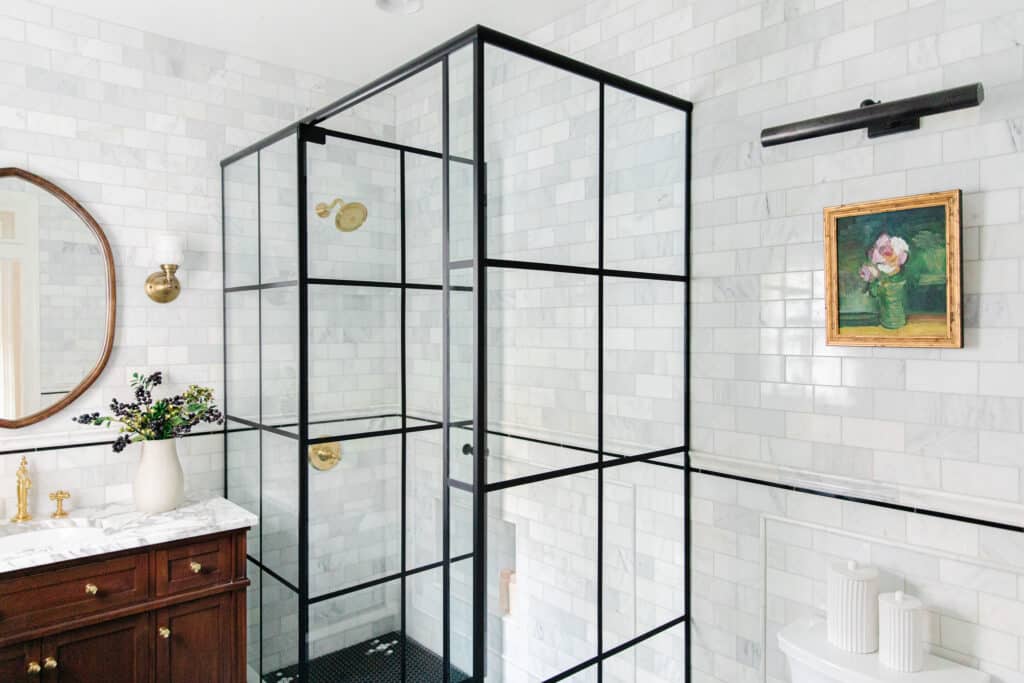
The Primary Bathroom & Closets

The Powder Bathroom

The Mudroom

The Bonus Room

Greta’s Room

Greta’s Bathroom
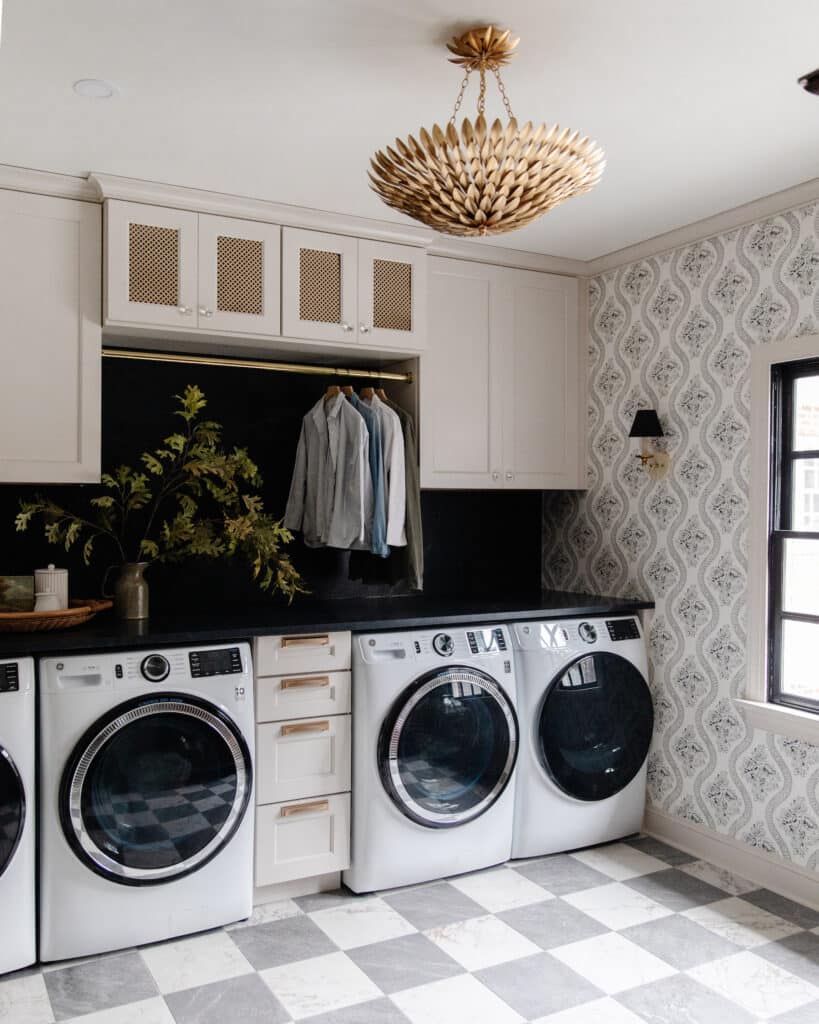
The Laundry Room
Polly’s Room

Faye’s Room

The Backyard

Lighting FAQ
How many light sources should I have in a room? At least 2–3, and ideally one from each layer (ambient, task, accent). Big living rooms can absolutely support 10+ without feeling overdone.
How high should I hang a chandelier over a dining table? 30–36 inches from the tabletop for a standard 8-foot ceiling. For vaulted or higher ceilings, size up and hang proportionally higher — we landed at 40 inches with our 12–16 foot vaults. [Full guide here]
What size chandelier do I need? A common formula: add the length and width of your room in feet, and that total in inches is a good starting diameter. Then size up, not down — nine out of ten times, bigger is better.
What Kelvin should my bulbs be? 2,700K–3,000K for almost every room in the house. Anything cooler feels like a dentist’s office.
Can I mix finishes? Yes. You can have several options if there are two dominant metals, repeated across sightlines.
Do I need an electrician for wall sconces? Hardwired, yes (unless you have junction boxes already). But plug-in sconces, picture lights, and rechargeable sconces are all renter- and DIY-friendly options.

The Takeaway
Lighting is the single biggest design lever you have — above paint color, above flooring, above almost any finish you can name. It’s also the one that’s most often undervalued and under-budgeted.
If you take nothing else from this post, take this: layer three types of light, size up your fixtures, and put almost everything on a dimmer. That’s 90% of how we get the moody modern traditional glow in our home
Lamp-o’clock forever.